Which flour actually makes better pasta – and which one belongs in your bowl tonight? After years of rolling, extruding and (occasionally) ruining dough, here is the honest answer, regional nuance and all.
Ask ten Italian nonne which flour makes the best pasta and you will get ten answers, a few raised eyebrows, and possibly an invitation to lunch. The proper selection of flour is one of the most argued-over topics in any Italian kitchen, and at the centre of it sit two contenders: semolina, the coarse, golden flour milled from durum wheat, and all-purpose flour, the soft, do-anything staple already in your cupboard.
The lazy version of this article would simply crown semolina the winner and send you on your way. We are not going to do that, because it is not quite true. The honest answer is more interesting: the right flour depends on the pasta you are making, where in Italy it comes from, and whether eggs are joining the party.
Antonio Carluccio built a whole philosophy around this kind of thinking – “use the best ingredients with minimum fuss for maximum flavour” – and flour is exactly the kind of “best ingredient” that quietly decides whether your dish sings or sags.
So let us settle it properly. We will look at what these flours actually are, why durum behaves so differently from soft wheat, the north-versus-south divide that most guides skip entirely, and what we have learned testing both in a real kitchen. By the end you will know exactly which bag to reach for – and why.
For dried and shaped pasta – spaghetti, orecchiette, rigatoni, penne – semolina (durum) wins. It gives that firm, al dente bite, a rough surface that grips sauce, and a golden colour. For fresh egg pasta – tagliatelle, ravioli, tortellini – a soft wheat flour like Italian tipo 00 (or all-purpose in a pinch) is the traditional, silkier choice. All-purpose flour makes perfectly good pasta; it simply makes a softer pasta. The cleverest home cooks often blend the two.
What Semolina Flour Actually Is
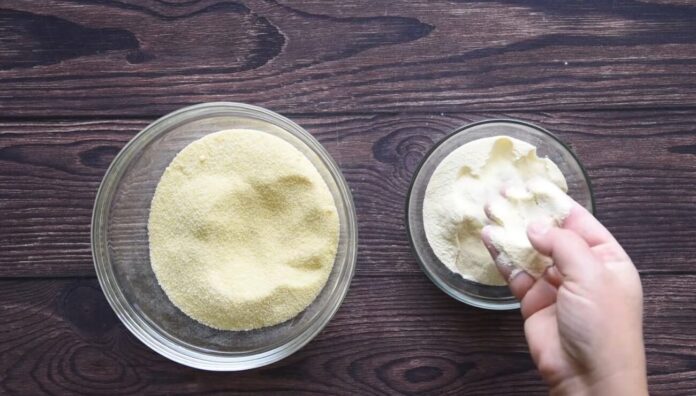
Semolina is the coarsely ground endosperm of durum wheat (Triticum durum), the hardest wheat there is.
As King Arthur Baking puts it, of all the major wheat types durum is “the hardest of them all,” with a high protein content that is excellent for gluten formation. That hardness is the whole story – it is why durum behaves like no other flour in a pasta dough.
You can feel the difference before you add a drop of water. In his book Flour, food writer Jordan Mackay describes how semolina has a “glass-like” quality that causes it to shatter into tiny crystals when milled, rather than collapsing into a soft powder like ordinary flour.
Run it through your fingers and it feels like fine, dry sand. Soft wheat flour, by contrast, feels like talc. That gritty texture is your first clue that you are holding something built for structure.
The word itself gives the game away. Semolina comes from the Italian semolino, from semola (“coarse grains”), tracing back to the Latin simila, meaning fine flour. Durum’s naturally golden endosperm is what gives both the flour and the finished pasta that warm, sun-yellow colour – a visual shorthand for quality that no soft-wheat noodle can fake.
One important point that trips up a lot of home cooks: the bag of “semolina” you buy for dusting is usually quite coarse.
The flour Italians actually use for pasta is semola rimacinata di grano duro – durum semolina that has been milled a second time to a finer, sandier grind.
As the team at Pasta Academy warns, people “often mix this flour up with regular semolina, which is a completely different product.” If your homemade pasta dough feels impossibly stiff and crumbly, this is very often the culprit.
All-Purpose Flour and Tipo 00: The Soft-Wheat Side
All-purpose flour is a blend of hard and soft wheat, milled fine and bleached or unbleached depending on the brand.
Its protein content typically lands around 10-12% – moderate, flexible, and deliberately neutral so it can handle everything from cookies to gravy.
That versatility is its strength in baking and its weakness in pasta: it has neither the protein nor the gritty backbone of durum, so pasta made purely from it tends to come out softer, paler and quicker to overcook.
Then there is Italy’s famous tipo 00. This is where almost everyone gets confused, so let us be precise: “00” refers to how finely the flour is milled, not to the type of wheat or its protein level.
As Pasta Evangelists and Cristina’s Kitchen both explain, Italian flours are graded by fineness – 2, 1, 0, then 00, the silkiest powder of all.
Most 00 sold for pasta is soft wheat, which is why it produces a tender, satiny dough that rolls into gossamer sheets, ideal for tagliatelle and ravioli.
Think of all-purpose flour as the widely available cousin of 00: not identical, but close enough to stand in.
Semola / semolina (durum, hard wheat): coarse, golden, high-protein. Built for dried and water-based pasta. Tipo 00 (soft wheat, finely milled): silky, tender. Built for fresh egg pasta. All-purpose (hard + soft blend): the flexible stand-in for 00, slightly more bite, always on hand.
The Real Divide Isn’t “Better vs Worse” – It’s North vs South
Here is the context most flour comparisons leave out entirely, and it changes everything. In Italy, the choice between durum and soft wheat is not a quality contest – it is geography and tradition.
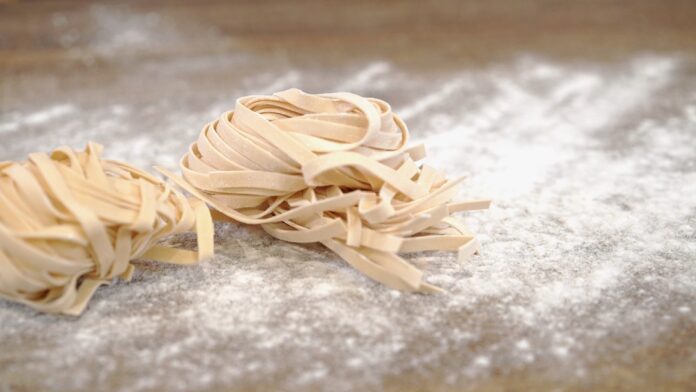
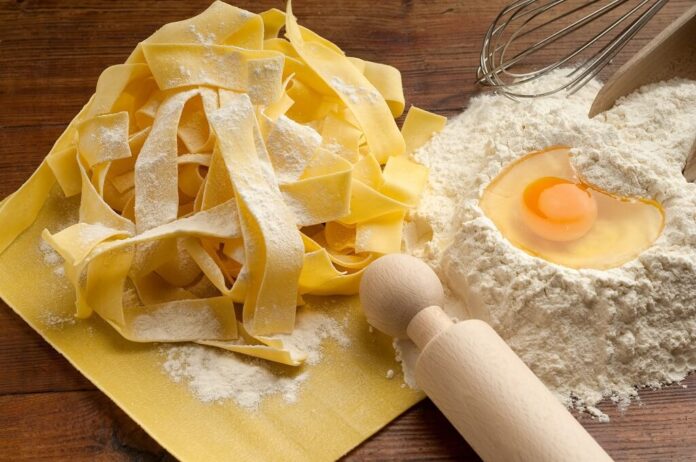
In the north, especially Emilia-Romagna, pasta means pasta all’uovo – soft wheat flour (00 or all-purpose) bound with eggs. This is the home of silky tagliatelle al ragù, tortellini in brodo and tender filled pastas.
The classic ratio is beautifully simple: one large egg (around 100 grams of egg) per 100 grams of flour, a guideline you will find printed on the back of Italian flour bags and echoed by chefs from Pasta Academy to private chefs cooking in northern Italy today.
In the centre and south – Puglia, Sicily, Abruzzo, Calabria – pasta is pasta di semola: nothing but durum semolina and water, no eggs at all.
The q.b. Cucina guide sums up the rule of thumb nicely: soft wheat for northern doughs, durum for the “dragged” pasta shapes of the south. This is the dough behind Puglia’s orecchiette, Liguria’s trofie, Tuscany’s hand-rolled pici, and the original spaghetti of Sicily and Abruzzo.
Carluccio loved this southern tradition. Writing about orecchiette – “little ears” – he pictured the nonne of Bari working dough of nothing more than durum semolina and water, dragging each piece across a wooden board with a blunt knife. It is cucina povera at its finest: humble flour, water, hands, and centuries of practice. No eggs, no gadgets, no fuss.
A fair word of caution, because Italians will be the first to say it: these are guidelines, not laws. As Cristina’s Kitchen notes, pici can be made with egg, and tagliatelle can be made with semolina and water – “it all depends on the cook and the recipe.”
The point is not to memorise rules but to understand why each flour suits each pasta. Once you grasp that, you can break the rules on purpose.
Semolina vs All-Purpose Flour: A Head-to-Head Comparison
Stripping away the romance, here is how the two flours stack up where it matters for pasta. (For all-purpose, read “soft wheat” more broadly – the same logic applies to 00.)
| Property | Semolina (durum) | All-purpose flour |
|---|---|---|
| Protein content | ~12–13% (high) | ~10–12% (moderate) |
| Gluten strength | Strong, tight network | Weaker, softer network |
| Texture | Coarse, sandy, granular | Fine, smooth, powdery |
| Colour | Golden yellow | Pale, off-white |
| Flavour | Nutty, faintly sweet, wheaty | Neutral, mild |
| Dough handling | Firm; springs back; loves an extruder or a good rest | Soft, supple; rolls thin easily (especially with egg) |
| Sauce grip | Rough surface clings to sauce | Smoother surface; sauce slides more |
| Cooking outcome | Holds shape; reliable al dente bite | Softer; overcooks and turns mushy faster |
| Best for | Dried & shaped pasta, southern shapes, pizza | Fresh egg pasta, filled pasta, everyday baking |
Why durum holds its bite: the science of al dente
That prized firmness is not folklore – it is structural. Durum’s strong gluten forms a dense matrix that physically traps the starch granules.
When pasta cooks, that tight protein network limits how quickly water (and later, your digestive enzymes) can reach the starch. The result is pasta that resists turning to mush.
A 2022 study in the journal Foods describes exactly this: the “compact and dense structure” in which the gluten network surrounds the starch is what gives durum pasta its character. Soft wheat simply cannot build that wall as well.
This is also why durum semolina is, in the words of one peer-reviewed analysis, “the preferred and most often used raw material for the production of good-quality pasta.” It is not snobbery – it is food science.
Which Flour for Which Pasta: A Practical Guide
If you remember nothing else, remember this rough map:
- Dried, extruded shapes (penne, rigatoni, spaghetti, bucatini): 100% durum semolina and water. The dough is too tough to roll by hand comfortably – this is a job for a pasta machine or extruder.
- Hand-shaped southern pasta (orecchiette, cavatelli, trofie, pici): semola rimacinata and warm water. Forgiving, eggless, and deeply satisfying to make.
- Fresh egg ribbons and sheets (tagliatelle, pappardelle, lasagne): 00 or all-purpose flour with eggs, at roughly 100g flour per egg. Silky and tender.
- Filled pasta (ravioli, tortellini, agnolotti): 00 or all-purpose with egg – you need a soft, pliable sheet that seals without cracking.
- The best-of-both home dough: a 50/50 blend of semola rimacinata and 00 (or all-purpose) with egg. You get tenderness and bite, and the dough is more forgiving for beginners.
There is one more reason serious cooks reach for durum, and it shows up most clearly in good dried pasta.
The best brands are extruded through bronze dies (trafilata al bronzo), which roughens the surface so sauce clings instead of sliding.
Carluccio always pointed to this when choosing dried pasta: durum semolina plus a bronze die equals a noodle that actually holds your ragù. Check the packet – it is usually a sign of quality.
What We’ve Learned Testing Both in the Kitchen
Reading about flour is one thing; getting it under your fingernails is another. A few honest observations from making a lot of pasta both ways:
The finger test never lies
Before you commit, pinch each flour. Semolina (and especially semola rimacinata) feels faintly gritty, like fine, clean sand.
All-purpose feels soft and slippery. If a recipe calls for “semolina” and your flour feels like talcum powder, you have the wrong bag – stop and check the label before you waste good eggs.
All-purpose pasta forgives nothing in the pot
The clearest lesson came from a side-by-side batch of fresh tagliatelle: one made with all-purpose only, one with a semola-and-egg blend.
Both rolled beautifully. But left in boiling water even a minute too long, the all-purpose batch went pale, soft and faintly gummy, and the sauce slid straight off.
The semola batch stayed toothsome and gripped the sauce. All-purpose pasta is delicious – it just demands you stand over the pot and pull it early.
Semolina is the best dusting flour you are not using
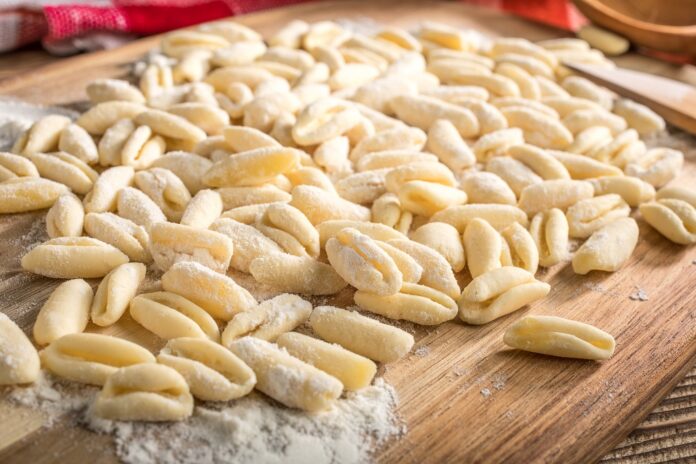
Coarse semolina is brilliant for dusting your work surface, your pasta, a pizza peel or a baking sheet. It behaves like tiny edible ball bearings: it stops sticking without gumming up the way fine flour does, and it does not scorch and turn bitter the way flour can on a hot stone. Once you dust your fresh pasta and trays with semolina, you will not go back.
When you only have all-purpose, lean on this trick
Out of durum? King Arthur Baking suggests substituting about 25% of the all-purpose flour in a recipe with semolina for extra flavour, colour and chew. In a fresh egg dough that small swap nudges everything in the right direction – a touch more bite, a hint of gold – without making the dough hard to roll. It is the easiest upgrade in this whole guide.
Can You Substitute One for the Other?
Yes – with eyes open. You can absolutely make pasta with all-purpose flour alone; generations of home cooks outside Italy have done exactly that, often adding egg to compensate.
The egg is doing real work here: its protein coats the starch and protects it from over-absorbing water, which is why egg pasta from soft flour still has structure. Without egg, a soft-flour dough drifts toward soft and dumpling-like.
Going the other way – 100% semolina with water and no machine – is harder than it looks by hand. The dough is stiff and wants to spring back; it needs a long rest and patient kneading.
For a first eggless attempt, start with semola rimacinata, use warm water, and give the dough at least 30 minutes under a bowl before you fight it. Better yet, blend it with a softer flour while you build confidence.
Nutrition: Is Semolina Pasta Actually Good for You?
| Nutrient | Amount (per 100g) |
| Calories | 360 kcal |
| Carbohydrates | 73 g |
| Protein | 12.7 g |
| Fiber | 3.9 g |
| Iron | ~3.1 mg* |
| Magnesium | 47 mg |
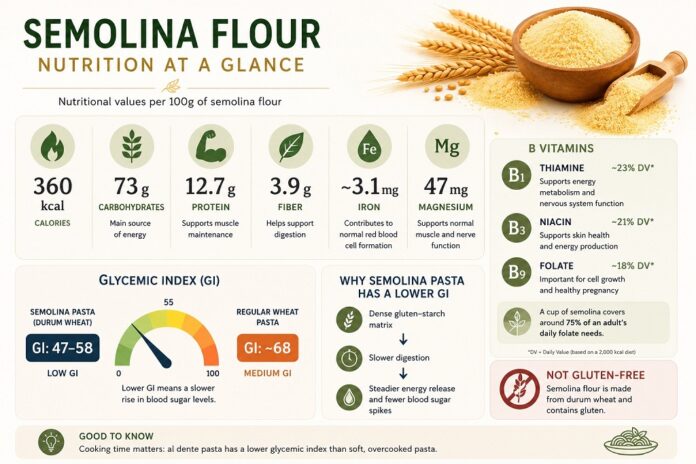
Beyond texture, durum semolina earns its place nutritionally. Per 100 grams, the flour delivers roughly 360 calories, 73g of carbohydrate, 12.7g of protein and 3.9g of fibre, along with a useful hit of B vitamins – thiamine (about 23% of the daily value), niacin (about 21%) and folate (about 18%).
That folate matters: a cup of semolina covers around three-quarters of an adult’s daily folate, which is part of why it is often recommended during pregnancy.
It also brings iron (about 7.3mg per cup) and magnesium (about 47mg per 100g). One practical tip: semolina’s iron is non-heme iron, which your body absorbs better alongside vitamin C – so a squeeze of lemon, a handful of cherry tomatoes or a side of broccoli genuinely helps.
A grating of sharp cheese to finish does not hurt either; if you are deciding between the two classics, our guide to Pecorino Romano vs Parmesan breaks down which suits which sauce.
The headline health point is the glycemic index. Pasta from durum semolina sits low on the scale – WebMD cites a GI of around 47, versus about 68 for pasta made from regular wheat, and other measurements put well-made durum pasta in the 47–58 range.
The reason is that same dense gluten-starch matrix: it slows digestion, so glucose enters the bloodstream gradually rather than spiking. A meta-analysis by Chiavaroli and colleagues found pasta fits comfortably into low-GI eating patterns.
Cooking time changes the numbers. Al dente pasta has a lower glycemic index than soft, overcooked pasta – the firmer the starch structure, the slower the sugar release. So the Italian habit of pulling pasta early is not just about taste; it is quietly better for your blood sugar too.
Beyond Pasta: Where Else Semolina Shines
Semolina is a one-ingredient passport to dozens of cuisines. A quick tour:
- Bread and pizza: a portion of semolina gives loaves a crisp crust and open crumb, and lends pizza dough a sturdy, chewy base. For the dough itself, follow Carluccio’s own recipe for the perfect pizza – then settle the sauce question with our guide to pizza sauce vs marinara.
- Couscous: the North African staple is, at heart, hand-rolled semolina – a reminder that this grain travelled far beyond Italy.
- Sweets around the world: Indian sooji halwa, Middle Eastern basbousa, Greek galaktoboureko, and the comforting milk puddings of Eastern Europe (Grießbrei) all lean on semolina’s ability to swell and set.
- Savoury classics: Indian upma, Roman gnocchi alla romana baked with cheese and béchamel, and Nigerian semolina fufu all show its range.
- As a thickener and a dusting flour: it adds silky body to soups and custards, and replaces cornmeal under breads and pizzas with a subtler, nuttier finish.
How to Buy and Store Flour for Pasta?
A few buying notes that save grief later:
- For homemade pasta, look for semola di grano duro rimacinata (twice-milled durum semolina) rather than plain coarse semolina.
- For fresh egg pasta, tipo 00 is ideal, but unbleached all-purpose is a fine everyday substitute.
- For dried pasta off the shelf, read the label for “durum wheat semolina” and trafilata al bronzo (bronze-die extruded) for the best texture and sauce grip.
- Storage: keep flour in an airtight container somewhere cool and dry. Whole-grain semolina contains more of the oil-rich germ, so it goes stale faster – buy it in smaller amounts or refrigerate it.
Once the pasta is made, the clock starts differently depending on whether it is fresh, dried or cooked. Our guide to how long pasta lasts in the fridge covers each type in detail – useful reading before you batch-cook a weekend’s worth of fresh tagliatelle.
The Verdict
If we have to plant a flag: for the pasta most people picture – a bowl of properly al dente spaghetti or a plate of orecchiette with a sauce that actually clings – semolina is the better flour, full stop. The higher protein, the stronger gluten, the golden colour, the nutty flavour and the lower glycemic index all line up behind it, and the food science backs it up.
But “better” is not the same as “always.” For a silky sheet of fresh egg tagliatelle or a delicate plate of ravioli, soft wheat – 00 or all-purpose – is not a compromise; it is the authentic choice, the one northern Italians have made for centuries.
All-purpose flour remains a genuinely good, always-available option, especially with an egg in the mix and a watchful eye on the pot.
The real upgrade is understanding why – so you stop asking which flour is best and start asking which flour is best for this dish. That is exactly the kind of small, honest decision that, in Carluccio’s words, turns the best ingredients into maximum flavour.
Buy a bag of semola rimacinata, keep your 00 or all-purpose close, and start cooking. The arguing is half the fun anyway.
Ready to put the flour to work? Our collection of authentic and traditional Italian recipes spans both traditions – from northern egg pasta dishes to southern semolina classics.
Frequently Asked Questions
Sources & Further Reading
- King Arthur Baking – What is semolina flour and how do I bake with it
- Pasta Evangelists – What flour should I use for making pasta
- Cristina’s Kitchen – Choosing the best flour for homemade pasta
- q.b. Cucina – Guide to Italian Flour
- Pasta Academy – Making pasta dough
- WebMD – Health Benefits of Semolina Flour
- Foods (2022), NIH/PMC – Low-GI durum wheat pasta and the gluten-starch matrix
- ScienceDirect – Digestibility of pasta made with three wheat types
- Gulf News – Antonio Carluccio on the ingredients for success
Editorial note: nutritional figures are approximate and vary by brand and milling; treat them as a general guide rather than exact values. This article is for general information and is not medical or dietary advice.