Are you in search of a perfect dinnerware set for everyday use, but you aren’t sure which one would suit your needs best?
We’re here to help!
Finding relevant info about the best dinnerware can often be quite tiresome and time-consuming.
The reason why is that you will encounter a deluge of results once you start searching the Internet, and going through these results will require a lot of time and effort.
You may even encounter info that is not entirely correct or complete, which in itself also presents quite an issue.
Not to worry, though! You don’t have to spend an eternity looking for answers by yourself when you have us.
We’re here to walk you through all you need to know about Corelle and porcelain dinnerware.
We’ll explain what Corelle and porcelain dinnerware are, how it is made, which one is better, and more.
Why spend an eternity looking for answers on your own when you can find out all there is to know in only a few minutes?
Let’s begin!
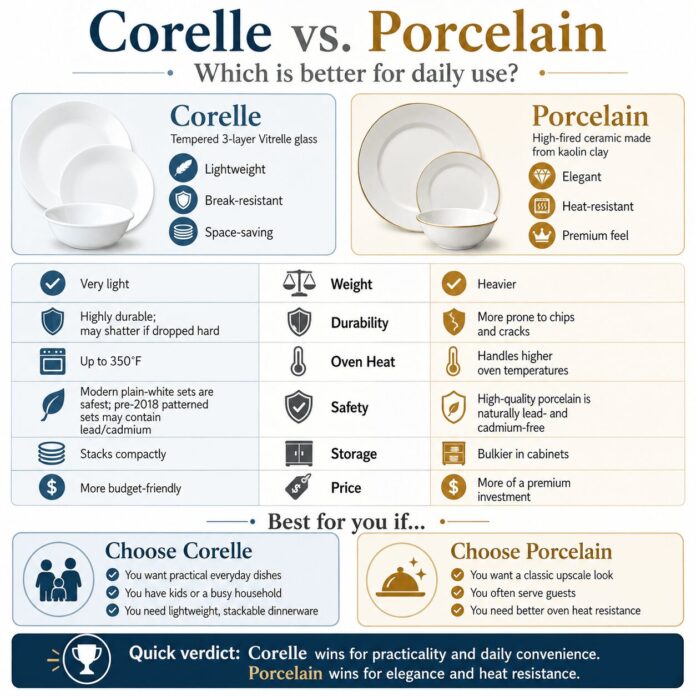
Corelle Dinnerware: The Modern Engineered Glass
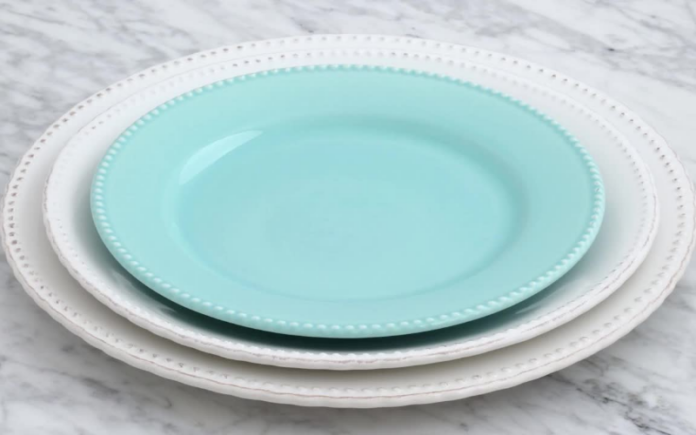
We’ll begin by explaining what Corelle and porcelain dinnerware are and how they are made so that you can better understand which one would suit your needs better.
We’re going to start with Corelle.
Corelle is a very well-known and popular brand of glassware and dishware.
It was first introduced way back in 1970, and it has since become quite a recognized option globally.
Corelle dinnerware is made of a unique tempered glass material called Vitrelle, which consists of two different types of glass put together and laminated into 3 layers. This proprietary technology gives the dishes their signature lightweight profile and incredible resistance to physical shock.
Corelle dishes are highly durable, sturdy, and resistant to breaking, chipping, and cracking.
It’s an excellent choice for daily use due to its benefits, especially for families with kids or elderly members who need lightweight, easy-to-handle dishes.
Real User Experience (Reddit BuyItForLife):
“My mother has two sets that are 30+ years old… they do show some cutlery marks that look like metallic scratches after a decade, but they are nearly indestructible. They stack so efficiently that you can easily fit 12 Corelle plates in the cupboard space where only 3 or 4 regular ceramic plates would fit.”
The Heavy Metal Question: Lead and Cadmium Free?
If you’re wondering whether Corelle dinnerware is lead and cadmium-free, the answer is—not necessarily.
What this means is that Corelle officially started producing completely lead-free dinnerware in 2018.
So, if you get a vintage Corelle dinnerware set that was made before 2018, chances are it will contain lead and/or cadmium in its painted patterns.
You can choose a safer option if you decide to purchase a Corelle dinnerware and choose a classic, plain white Corelle set.
These white sets usually don’t contain any toxic and harmful chemicals, as opposed to older sets that feature colorful, vintage designs.
Porcelain Dinnerware: The Timeless Ceramic Elegance
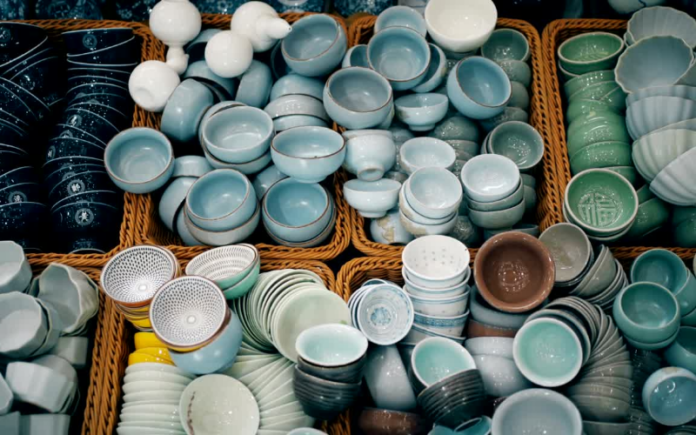
Now that you know what Corelle is and how it’s made, it is time to move on to porcelain dinnerware.
Porcelain dinnerware is typically made of kaolin, which is better known as China clay.
It’s one of the most popular dinnerware options out there, both for at-home use and high-end restaurants.
It usually features a very classic white design that people love because they can use it for every occasion—from casual breakfasts to formal dinner parties.
The materials used to make porcelain dinnerware are very fine, high in quality, and naturally non-toxic.
These materials are fired at extremely high temperatures (often exceeding 2,300°F/1,200°C) during manufacturing, which results in a dense, non-porous, and completely vitrified dish that is safe to use at all times.
As opposed to Corelle, porcelain dinnerware is much more heat resistant.
While you shouldn’t use Corelle dinnerware at temperatures higher than 350 degrees Fahrenheit, high-quality porcelain dishes can safely withstand much higher oven temperatures.
Furthermore, porcelain does not absorb moisture, meaning it won’t get dangerously hot in the microwave like cheaper stoneware often does. However, porcelain dinnerware is inherently more brittle and heavier than Corelle, making it more prone to chipping and cracking if bumped against the sink or countertop.
Corelle Vs. Porcelain—Which Is Better?
Both Corelle and Porcelain dinnerware have their advantages and disadvantages, so making sure you choose the right set for your needs can be a difficult decision.
You need to consider every pro and every con that these two dinnerware sets have if you want to end up getting one that meets your requirements and that you can use daily without encountering any issues.
To make this decision less difficult, we provide you with a detailed breakdown of their pros and cons based on lab specifications and long-term kitchen testing.
Corelle Dinnerware
- Dishwasher Safe: You can save time and put it in your dishwasher instead of scrubbing it by hand.
- Highly Durable & Break-Resistant: Made from 3-layer Vitrelle glass, it is highly resistant to chips, scratches, and stains.
- Ultra-Lightweight & Stackable: Perfect for children, the elderly, and small kitchens, as they take up minimal cabinet space.
- Temperature Versatile: Safe for use in the freezer, refrigerator, and microwave.
- Vintage Safety Concerns: Pre-2018 patterned sets can contain lead or other heavy metals.
- The “Shatter” Risk: While hard to break, if dropped on hard tile floors, Corelle doesn’t just crack—it can shatter loudly into thousands of tiny, needle-like glass shards.
- Oven Limitations: Cannot be used at extreme temperatures above 350°F.
Porcelain Dinnerware
- Superior Oven Heat Resistance: Can handle much higher cooking and warming temperatures than Corelle.
- Naturally Chemical-Free: High-quality porcelain is completely non-toxic, lead-free, and cadmium-free.
- Elegant Aesthetic: Provides a heavy, premium feel that elevates the dining experience and feels more upscale for entertaining.
- Easy to Clean: Non-porous glaze creates a non-stick surface that resists food stains.
- Prone to Chipping: Edges can chip or crack easily if knocked against stone countertops or other dishes in the sink.
- Heavy and Bulky: Much heavier to carry in bulk and takes up significantly more vertical space in kitchen cabinets.
Price Comparison: Budget vs. Investment
If you’re curious about the prices, we got you covered. Corelle dinnerware sets are typically more affordable and economical than high-grade porcelain ones.
The exact price depends on the specific set and pattern you choose, but if you’re looking for a less expensive, highly practical option that offers incredible longevity for the price, Corelle is the clear winner. Porcelain stands as a premium investment for those who value traditional table aesthetics.
Conclusion: Which One Ticks Your Boxes?
In conclusion, both Corelle and porcelain dinnerware sets have unique, distinct benefits.
If your priority is an elegant, premium-feeling set that is 100% toxic-chemical free, handles high oven temperatures, and adds a classic restaurant feel to your table, **porcelain** is your best bet.
However, if you have a busy household with kids, limited cabinet space, and want a budget-friendly set that is virtually indestructible under normal use—and you don’t mind staying below 350°F—then a modern **Corelle** set is your ideal choice.
Think about how you cook, wash, and store your dishes daily to make the perfect final decision. Both are exceptional materials, so analyze your household habits and pick the one that fits your lifestyle seamlessly!